
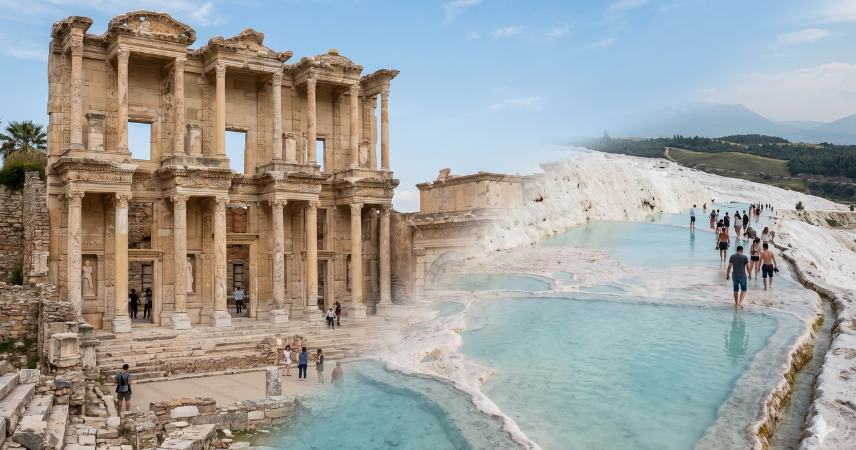
Short answer: yes, you absolutely can visit Ephesus and Pamukkale in 2 days. But let’s be honest – it will be a fast-paced 48 hours with early mornings, roughly 3 to 3.5 hours of travel between sites, and not much room for leisurely meals or detours.
This travel guide breaks down the exact logistics, realistic schedules, entrance gates, ticket costs, and transport options you need to pull off this Turkey 2-day itinerary without losing your mind. No fluff. Just the practical information you need to plan your trip efficiently.
Can You Visit Ephesus and Pamukkale in 2 Days? (Short Answer)
Yes. Two days is enough to see the main highlights of both destinations – but only if you plan carefully and accept a brisk pace.
Here’s what you’re working with. Ephesus is an ancient city located near the small town of Selçuk on the aegean coast of Turkey. It’s one of Europe’s most complete surviving cities from the Roman Empire era, featuring the iconic Library of Celsus, a 25,000-seat theatre, and remarkably well preserved ruins. You’ll need 3 to 4 hours inside the archaeological site itself.
Pamukkale, meaning cotton castle in Turkish, sits near the city of Denizli in denizli province. It’s a UNESCO world heritage site famous for its white travertine terraces and the ancient Greco-Roman city of Hierapolis perched above. Budget 3 to 4 hours here as well.
Between Selçuk and Denizli, the travel time runs approximately 3 to 3.5 hours by train or car. Add the 25-minute dolmuş ride from Denizli to Pamukkale village, and you’re looking at roughly 4 hours door-to-door.
This article – written by Alpaca Travel, a receptive agency specializing in tours for English-speaking travelers – gives you concrete schedules, gate recommendations (including the south gate at Pamukkale), and top tips for first-time visitors tackling this day trip–style plan.
The Short Answer: Is 2 Days Enough for Ephesus and Pamukkale?
Two days is enough to see the essential highlights. It is not enough for slow, contemplative travel.
Ephesus is one of the most significant archaeological sites in the Mediterranean and has held UNESCO World Heritage status since 2019. Pamukkale features white travertine terraces formed by carbonate mineral left behind by mineral-rich thermal waters – one of the most striking natural wonders in the country. Together, they represent the best contrast Turkey has to offer: monumental ancient architecture meets surreal geological beauty.
Pros of the 2-day plan:
- You see two of Turkey’s most visited sites in minimal time
- Easy to connect from İzmir or Istanbul by flight plus train or bus
- Leaves room to extend into longer Turkey itineraries afterward
- Works well for travelers on tight schedules who prioritize iconic sites over depth
Cons you should know about:
- Early mornings and late arrivals are unavoidable
- Less time for museums, the full necropolis at Hierapolis, or relaxed meals
- Summer heat (35–40°C) makes fast-paced walking exhausting, especially on reflective marble and white travertine
- Not all of the sites can be explored thoroughly – you’re hitting highlights, not doing deep dives
This plan is ideal for: Solo travelers, couples, or small groups comfortable walking several kilometers per day who want to see the essentials efficiently.
Consider 3 days instead if: You’re traveling with young children, want serious wellness time in the hot springs, or you’re a history enthusiast who wants to spend hours inside the terrace houses and the Ephesus Archaeological Museum in Selçuk.
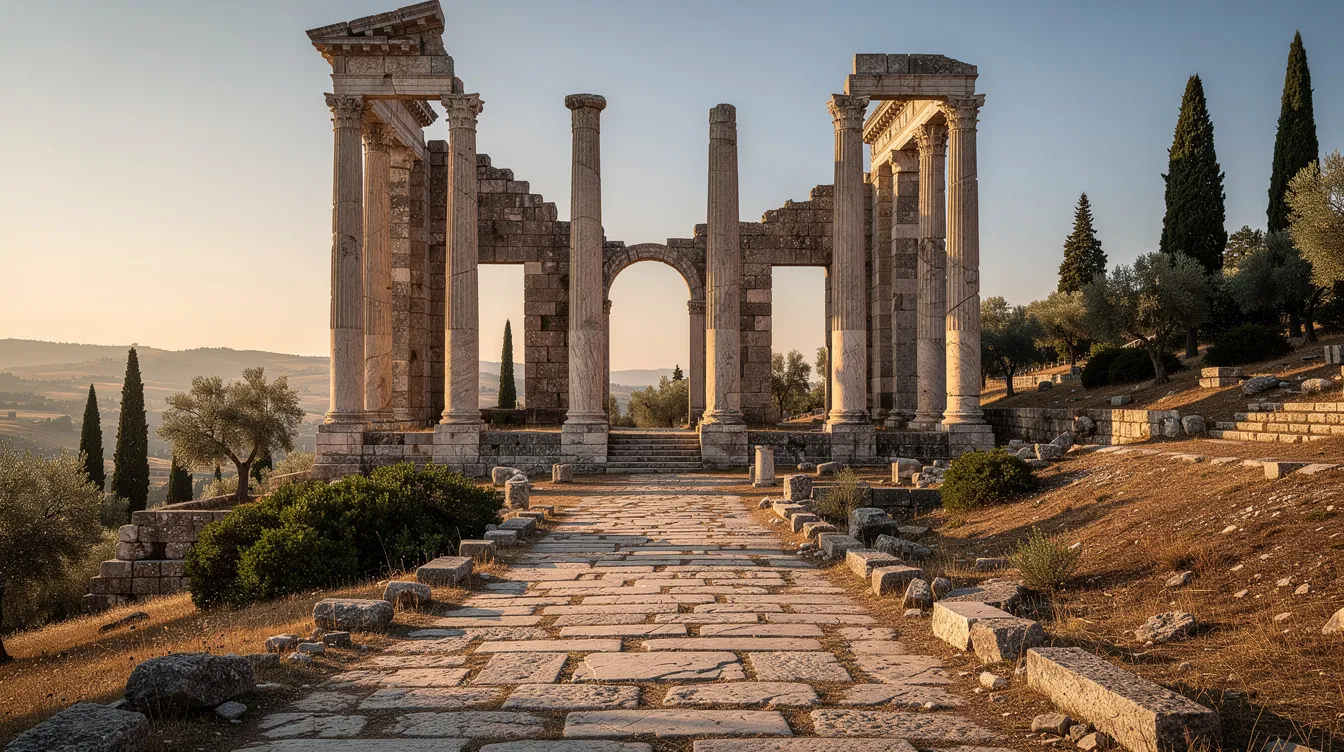
The Ultimate 2-Day Ephesus and Pamukkale Itinerary
This section gives you a concrete 48-hour schedule starting from Selçuk or İzmir, with time estimates for each stop.
All times are approximate and based on normal conditions – no extreme queues, average walking pace, and standard opening hours. The itinerary assumes you stay in Selçuk (or İzmir) for Night 0 and in Pamukkale village or Denizli for Night 1.
Day 1: Stepping Back in Time at Ephesus
Day 1 is entirely about exploring the ancient city of Ephesus near Selçuk, with optional side visits to the House of the Virgin Mary and the Temple of Artemis. If you’re transferring toward Denizli in the evening, you’ll want to manage your time carefully.
Morning (08:30–09:00): Arrive at the Upper Gate
Get to the upper (south) entrance of Ephesus shortly after opening to avoid the wave of tour buses that typically arrives between 09:30 and 10:30. The upper gate – also called the Magnesia Gate – lets you walk downhill through the entire site, which is far less tiring than the reverse.
Tickets cost approximately €40 for the main site. The terrace houses require a separate ticket at an extra cost of about €15, or you can grab a combo for around €52. Consider buying via the official portal to save time.
The Route Through the Ruins (09:00–12:30)
Walking from the upper entrance downhill, here’s what you’ll encounter in rough order:
- State Agora and Odeon – The civic centre of the old city, where political decisions were made. Ephesus was a major political hub in Asia Minor and one of the most important ionian cities of the ancient world.
- Curetes Street – The main boulevard, lined with monuments and inscriptions that reveal daily life in roman times. Ephesus was founded between the 16th and 11th centuries BC, with Greek colonists establishing it as a permanent settlement by the 10th century BC. By the first century BC, the city had a population of over 250,000 people.
- Temple of Hadrian – A beautifully decorated temple dedicated to the Roman Emperor Hadrian, with ornate friezes showing mythological scenes.
- Terrace Houses – These residences of Ephesus’s elite date back to the 1st century BC. The terrace houses feature beautifully preserved mosaics and frescoes that offer a direct glimpse into Hellenistic and Roman life. Ephesus had advanced plumbing systems including public toilets and a water heating system – remarkably sophisticated for an ancient city. Allow an extra 30–60 minutes here.
- Library of Celsus – The undisputed star of the site. The celsus library was once the third-largest library in the ancient world and held over 12,000 scrolls. Its two-story façade remains one of the most photographed monuments in all of turkey ephesus.
- Marble Street – Connecting the library to the theatre, this street features the world’s oldest known commercial advertisement – an engraved footprint believed to direct visitors to a nearby establishment.
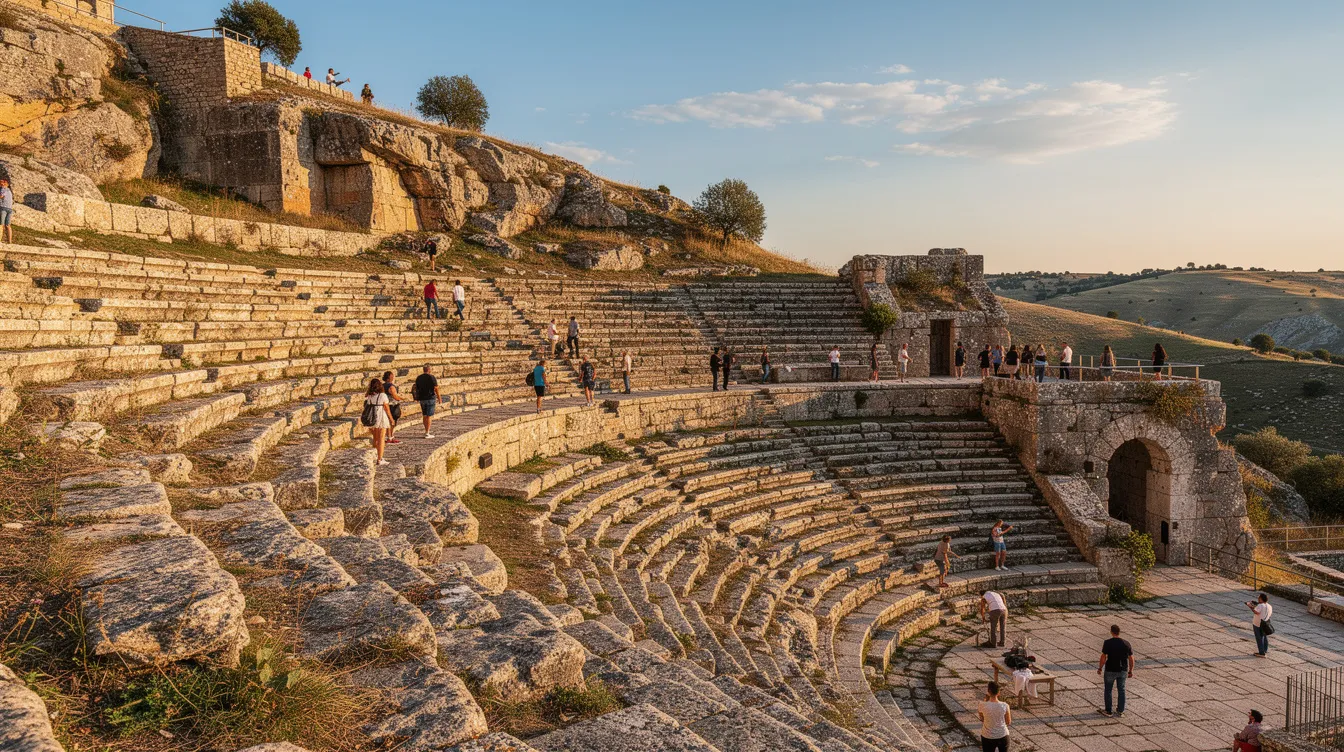
- Great Theatre – The great theatre of Ephesus could seat up to 25,000 people. This is where Apostle Paul preached and sparked a riot, as recorded in the Book of Acts. Ephesus was a center for Early Christianity from the AD 50s – Paul lived here from AD 52 to 54, John the apostle is believed to have died in the city, Saint Timothy served as its first bishop, the Third Ecumenical Council was held here in 431 AD, and the connection to Jesus Christ and early church history runs deep.
- Roman baths near the lower gate round out the walk. Ancient Ephesus was a vital commercial port, and these baths served the merchants and sailors who passed through.
Remember: Ephesus is one of Europe’s most complete ancient cities, yet only about 20% has been excavated. Ongoing archeological excavations continue to reveal new structures every season.
Midday (12:30–14:00): Lunch and Bonus Stops
Head into the nearby town of Selçuk for lunch. If time allows, consider:
- Ephesus Archaeological Museum – Small but excellent collection (~€10, about 1 hour)
- Basilica of St. John on ayasuluk hill (~€6, 30–45 minutes) – tradition holds that John’s tomb is located here
- Temple of Artemis – Once one of the seven wonders of the ancient world, the temple of artemis was among the largest temples ever built. Today only a single column remains, but the location is worth a brief stop for context.
Afternoon Option: House of the Virgin Mary
The House of the Virgin Mary is located about 20–25 minutes by car from the ruins on Mount Koressos. This house, surrounded by forest, is where virgin mary is believed to have spent her final years. Budget about 1–1.5 hours including transport. Entry is approximately €18.
Evening Logistics: Getting to Pamukkale
You have two choices:
- Stay a second night in Selçuk and take an early morning train from Selçuk to Denizli on Day 2
- Depart late afternoon (around 16:00–17:00) by car or bus toward Pamukkale, arriving by 20:00–21:00
Option 2 gives you more time at Pamukkale on the second day. Option 1 is less exhausting.
Alpaca Travel can arrange English-speaking guides at Ephesus, private transfers between sites, and tailored pacing for small groups – including shaded breaks and a less rushed walking route.
Day 2: The White Terraces of Pamukkale & Ancient Hierapolis
Day 2 is dedicated to visiting Pamukkale’s travertine terraces and the ancient city of Hierapolis, located atop the terraces. Both are accessed with a single combined ticket costing approximately €30.
Early Morning (08:00–08:30): Enter via the South Gate
The south gate offers the most direct access to the travertine terraces on foot. Arriving at opening time means quieter pools, softer morning light, and cooler temperatures – critical in summer. Many large tour groups use the north gate and arrive later in the morning, so the south entrance gives you a head start.
Travertine Terraces (08:30–10:00)
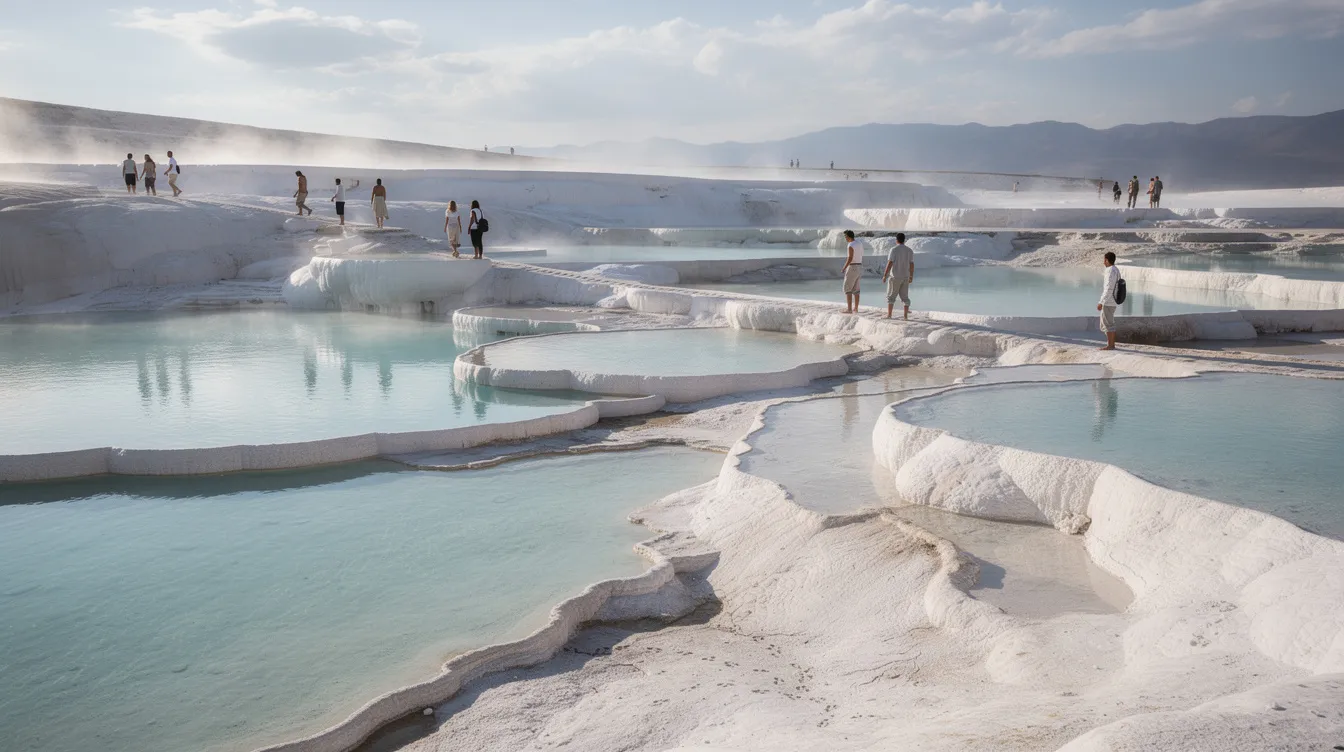
You must walk barefoot on the white cascades – shoes are not allowed on the travertines. The carbonate mineral deposits create shallow warm pools that step down the hillside like a frozen waterfall. The thermal pools in Pamukkale have a water temperature of around 35°C.
Pack a waterproof bag for your electronics, wear swimwear you can walk in, and bring a quick-dry towel. Allow 1–2 hours here, including photo stops.
Hierapolis (10:00–12:00)
From the top of the terraces, walk into the ruins of Hierapolis. This ancient city thrived as a thermal spa destination during the Roman Empire. Key stops include:
- The Roman baths near the site entrance, now housing a small archaeology museum
- The central colonnaded street running through the old city
- The Hierapolis Theatre – a remarkably intact 15,000-seat structure with sweeping valley views
- Sections of the necropolis, one of the largest and best-preserved ancient cemeteries in the new city of archaeological discoveries in Turkey
Cleopatra’s Antique Pool (12:00–13:30)
Swimming among submerged Roman columns in warm thermal water is one of those experiences that sounds too dramatic to be real – but it is. Entry costs an additional ~€6. Allow 1–1.5 hours including changing time and a brief snack break.
Overall timing: Plan for 3–4 hours total inside Pamukkale and Hierapolis at a comfortable but brisk pace. Add lunch in Pamukkale town or near the south gate.
Evening Departure
After your visit, options include:
- Return to denizli bus station or train station for onward travel
- Take an evening bus to İzmir, Antalya, or Fethiye
- Extend your trip with an extra night to explore the area at a slower pace
Alpaca Travel can integrate this Day 2 into longer routes – for example, the Turquía Fantástica package continues to Cappadocia with coordinated transfers for English-speaking travellers.
How to Travel Between Ephesus (Selçuk) and Pamukkale (Denizli)
The distance between Selçuk and Pamukkale is roughly 190–200 km. Here’s how to cover it:
| Transport | Duration | Approximate Cost | Notes |
|---|---|---|---|
| Train (Selçuk → Denizli) | ~3h 30m | ~₺170 | Regional TCDD service; check schedules |
| Bus (Selçuk → Denizli) | 3.5–4h | Varies | Intercity buses; frequent from İzmir too |
| Rental car | ~3h | Fuel + tolls | Most flexible; easy parking near both sites |
| Private transfer | ~3h | Fixed fee | Door-to-door; no connections needed |
Train from Selçuk to Denizli: The most popular budget option. Several departures run daily, typically in the morning and afternoon. From Denizli station, you’ll need a dolmuş (minibus) to Pamukkale town – these depart every 15–20 minutes and take about 25 minutes.
Bus option: Frequent intercity buses connect Selçuk (or İzmir) with the Denizli otogar. From the denizli bus station, grab a dolmuş to Pamukkale village for a small local fare.
Renting a car: The best choice if you want flexibility to stop at viewpoints, leave early or late, and control your own schedule. The drive takes about 3 hours on main highways. Parking is available near both sites.
Private transfer or guided tour: Alpaca Travel arranges direct private transfers with English-speaking drivers between Selçuk, Ephesus, and Pamukkale, eliminating the stress of connections and timetables.
Important: Always factor in the transfer time between Denizli and Pamukkale (~30–40 minutes). Seasonal schedule changes affect trains and buses, so check current timetables before your trip, especially during high season from June through September.
Where to Stay for This 2-Day Trip
Your hotel choice directly affects how relaxed – or stressful – this 2-day plan feels.
Night 0 (before Day 1):
Stay in Selçuk for the quickest access to Ephesus. The town is small, walkable, and has charming guesthouses within minutes of the ruins. İzmir is a solid alternative if your flight arrives late – it has more hotels and better flight connections, but you’ll need about 1 hour to reach Ephesus the next morning.
Night 1 (between Day 1 and Day 2):
The best option is Pamukkale village. It’s a simple, tourist-focused town, but the convenience is unbeatable – you can walk to the south gate and be on the terraces within minutes of sunrise.
Alternatively, staying in Denizli city gives you more hotel choice and better transport links for onward travel. The tradeoff is a 20–25 km commute to the terraces each way.
Alpaca Travel works with carefully selected boutique hotels and mid-range comfort options at both locations, helping English-speaking guests choose based on budget and style. For such a tight schedule, booking cancellable rates is wise in case of flight or train changes – especially during peak holiday periods when hotels fill up fast.
Pro Tips for Maximizing Your Short Time
Here are the top tips that will make or break your 2-day trip:
- Start early. Be at Ephesus by 08:30 and at Pamukkale’s south gate by 08:00. This beats both the crowds and the worst of the midday heat.
- Buy tickets smartly. The Turkish Museum Pass (Aegean or All Turkey versions) can save you time at ticket windows. It covers Ephesus, the library of celsus complex area, and Pamukkale/Hierapolis.
- Pack for two different experiences. Comfortable walking shoes for Ephesus (uneven marble and stone), plus swimwear and a quick-dry towel for Pamukkale. A waterproof bag protects your phone on the wet terraces.
- Plan meals simply. Quick lunches near Selçuk on Day 1 and in Pamukkale town on Day 2. Don’t waste precious time hunting for restaurants far from the sites. Breakfast at your hotel is usually included.
- Stay hydrated. Carry a refillable water bottle. Summer temperatures regularly exceed 35°C, and both sites offer minimal shade. Spring and autumn (April–May, September–October) are significantly more comfortable for this kind of trip.
- Build time buffers. Add 30–45 minutes of padding around any train or bus departure from Denizli, Selçuk, or İzmir. You will want extra time for photo stops, and delays exiting the sites are common during peak hours.
- Let someone handle the logistics. Alpaca Travel can pre-arrange guides, transfers, and tickets so you can focus on the experience rather than managing every connection.
Conclusion: Can You Visit Ephesus and Pamukkale in 2 Days?
Yes – you can visit Ephesus and Pamukkale in 2 days, and thousands of travelers do it every year. It requires a well-planned schedule, but the payoff is extraordinary: two of Turkey’s most iconic cultural and natural sites experienced in a single 48-hour window.
The core plan is straightforward. Day 1 covers the Ephesus ruins – the library of Celsus, the great theatre, the terrace houses, and possibly the temple of artemis or the House of the Virgin Mary. Day 2 takes you to Pamukkale’s travertine terraces, Cleopatra’s Antique Pool, and the Hierapolis theatre.
The key to making it work is smart transport – whether that’s the train from Selçuk to Denizli, a rental car, or a private transfer – combined with staying close to the sites and using early mornings wisely.
If you can spare an extra day, you’ll enjoy a slower pace and deeper exploration of both locations. But if you can’t, this travel guide gives you everything you need to experience two of the world’s greatest sites efficiently and memorably.
Ready to explore these ancient wonders with English-speaking support? Alpaca Travel offers personalized Ephesus–Pamukkale itineraries with reliable local logistics, expert guides, and the kind of cultural insight that turns a rushed trip into something truly special.
Comments